Learning Intentions
Understand features of a good conversation.
Success Criteria
-
Watch "How to have a good conversation" by Celeste Headlee.
-
Complete the Consolidation Task provided.
What is communication?
Definition: Communication is when a message is sent by one person and received by another.
What is a good conversation?
A great conversation requires a balance between talking and listening. This balance is important because bad communication leads to bad relationships, at home, at work, everywhere.
How to Have a Good Conversation - Celeste Headlee
Science with Dobrich
Matter can be classified as pure substances such as elements and compounds or impure substances such as mixtures (including solutions), and can be modelled using the particle model; mixtures may have a uniform (homogeneous) or non-uniform (heterogeneous) composition and can be separated based on the properties of their components using techniques including filtration, decantation, evaporation, crystallisation, magnetic separation, distillation and chromatography.
![[1] Pure vs Impure Substances](https://static.wixstatic.com/media/11062b_fa4cfd04e99d45bea4b8c4c98f90316a~mv2.jpg/v1/fill/w_980,h_695,al_c,q_85,usm_0.66_1.00_0.01,enc_avif,quality_auto/11062b_fa4cfd04e99d45bea4b8c4c98f90316a~mv2.jpg)
[1] Pure vs. Impure Substances
Discussion Question
HOOK
Which is do you think is more pure? - bottled water or gold? Justify your selection.
With reference to the particle model - what do you think "pure" means?

LEARNING INTENTIONS:
Understand the difference between pure substances (elements and compounds) and impure substances (mixtures).
SUCCESS CRITERIA:
-
Define pure and impure substances.
-
Identify examples of each.
-
Use particle diagrams to represent pure substances and mixtures.
Pure vs Impure Substances
A pure substance is something that is made of just one kind of thing all the way through. For example, a bar of gold is only gold, and a glass of clean water is only water.
An impure substance is something that has more than one kind of thing mixed together. The parts are not stuck together permanently. Sometimes the mix looks the same everywhere, and sometimes you can see the different parts.
Pure or Impure?
STATIONS
Station 1
Copper Wire
Station 2
Table Salt (NaCl)
Station 3
Ocean Water / Salt Water
Station 4
Sand & Iron Filings
Station 5
Station 6
Station 7
Station 8
Station 9
Station 10
Soft Drink
PART 1: Examine the 10 samples around the room. Predict whether the sample would be classified by a as pure (made of just one kind of thing) or impure (made of more than one kind of thing mixed together). Explain your reasoning.
PART 2: Models are often used in science to represent things that are too big, too small, too complex, or too dangerous to study directly. If we use Legos to model the particle in each of these substances, does your initial prediction change or remain the same? Mouse over each of the images below to see their simplified particle models.

![IMG_9260[1].HEIC](https://static.wixstatic.com/media/dbd56f_684b09d570794386be53baf3880bcd13~mv2.png/v1/crop/x_0,y_504,w_3024,h_3024/fill/w_180,h_180,al_c,q_85,usm_0.66_1.00_0.01,enc_avif,quality_auto/IMG_9260%5B1%5D_HEIC.png)
![IMG_9260[1].HEIC](https://static.wixstatic.com/media/dbd56f_684b09d570794386be53baf3880bcd13~mv2.png/v1/crop/x_0,y_504,w_3024,h_3024/fill/w_165,h_168,al_c,q_85,usm_0.66_1.00_0.01,enc_avif,quality_auto/IMG_9260%5B1%5D_HEIC.png)

![IMG_9259[1]_edited.jpg](https://static.wixstatic.com/media/dbd56f_2bf242d71bd04148b0bffc8b11638c8b~mv2.jpg/v1/crop/x_12,y_0,w_2023,h_2047/fill/w_168,h_170,al_c,q_80,usm_0.66_1.00_0.01,enc_avif,quality_auto/IMG_9259%5B1%5D_edited.jpg)

![IMG_9264[1].HEIC](https://static.wixstatic.com/media/dbd56f_0ec0b0a8c9ed43428167d0eede78494a~mv2.png/v1/crop/x_0,y_486,w_3024,h_3060/fill/w_168,h_170,al_c,q_85,usm_0.66_1.00_0.01,enc_avif,quality_auto/IMG_9264%5B1%5D_HEIC.png)
Trail Mix / Muesli
Distilled Water
Jelly
Aluminum Foil
Dirt / Soil

_HEIC.png)

![IMG_9266[1].HEIC](https://static.wixstatic.com/media/dbd56f_615e558c8cf545d48b0bd0ede36cb917~mv2.png/v1/crop/x_0,y_288,w_3024,h_3060/fill/w_168,h_170,al_c,q_85,usm_0.66_1.00_0.01,enc_avif,quality_auto/IMG_9266%5B1%5D_HEIC.png)
.jpg)
![IMG_9268[1].HEIC](https://static.wixstatic.com/media/dbd56f_47703de6fa0947b0947653bc5ff061b3~mv2.png/v1/crop/x_0,y_486,w_3024,h_3060/fill/w_168,h_170,al_c,q_85,usm_0.66_1.00_0.01,enc_avif,quality_auto/IMG_9268%5B1%5D_HEIC.png)
.jpg)
![IMG_9265[1].HEIC](https://static.wixstatic.com/media/dbd56f_2c6832c83e6548fda64a47817e3116bc~mv2.png/v1/crop/x_0,y_378,w_3024,h_3060/fill/w_168,h_170,al_c,q_85,usm_0.66_1.00_0.01,enc_avif,quality_auto/IMG_9265%5B1%5D_HEIC.png)

![IMG_9267[1].HEIC](https://static.wixstatic.com/media/dbd56f_a8c6e171455d4a50b6766d4f8ae204e8~mv2.png/v1/crop/x_0,y_486,w_3024,h_3060/fill/w_168,h_170,al_c,q_85,usm_0.66_1.00_0.01,enc_avif,quality_auto/IMG_9267%5B1%5D_HEIC.png)


![IMG_9271[1].HEIC](https://static.wixstatic.com/media/dbd56f_ffc81a6a756648e7bc18daa46637b866~mv2.png/v1/crop/x_0,y_486,w_3024,h_3060/fill/w_168,h_170,al_c,q_85,usm_0.66_1.00_0.01,enc_avif,quality_auto/IMG_9271%5B1%5D_HEIC.png)
-
Watch the concept attainment video - Pure or Impure?
-
As you watch, assess whether your predictions from the previous stations were correct.
-
Assess your understanding of pure vs impure substances by describing each in one sentence and providing examples for each.
Check your understanding...
FLOW CHART: Pure vs Impure Substances

SUCCESS CRITERIA CHECKPOINT
CLOZE
✅ Define pure and impure substances.
✅Identify examples of each.
✅ Use particle diagrams to represent pure substances and mixtures.
[2] Pure Substances
What do you breathe?
HOOK
1. What do humans breathe? Compare this to fish - what do fish breathe?
2. Would you rather live somewhere with thin air (like on a mountain) or thick air (like deep underwater in a submarine)?
3. If you could see the air around you, what do you think it would look like?

LEARNING INTENTIONS:
Understand the particles arrangements of pure substances (elements and compounds) and provide examples.
SUCCESS CRITERIA:
-
Define pure substances.
-
Outline characteristics of pure substances.
-
List examples of pure substances.
Understanding Pure Substances: Oxygen vs Air
Oxygen gas is a pure substance because it is made up of only one type of molecule — oxygen (O₂). Every particle in a sample of pure oxygen is the same, so it has consistent properties like density and boiling point.
Air, on the other hand, is a mixture of several gases, mainly nitrogen (~78%) and oxygen (~21%), with small amounts of carbon dioxide, water vapour, and other gases. Because it contains different substances mixed together, the exact composition of air can vary from place to place and time to time, and its properties depend on the proportions of those gases.
Now - view the videos below to learn what would happen if you breathed in pure oxygen gas as opposed to the 20% mixture currently present on Earth.

SUMMARY: Pure Substances
In summary, a pure substance is made of only one type of particle. That means it has the same composition all the way through and can’t be separated into other substances by physical means. There are two types of pure substances:
-
Elements (like oxygen gas, gold, or copper) are pure substances made of one kind of atom.
-
Compounds (like water or salt) are pure substances made of molecules that are chemically joined in a fixed ratio.
GUIDED ACTIVITY
INSTRUCTIONS: WIth your teacher's guidance, complete the Frayer Model summarising pure substances. You will need to: define pure substances, outline characteristics of pure substances, and list examples and non-examples of pure substances.
Frayer Model - Pure Substances

Chemistry Collage
ACTIVITY
INSTRUCTIONS: Use the information from your Frayer Model to create a collage or poster visually summarising pure substances, their characteristics and examples (including particle examples).
SUCCESS CRITERIA CHECKPOINT
CLOZE
✅ Define pure substances.
✅ Outline characteristics of pure substances.
✅ List examples of pure substances
[3] Impure Substances
Which would you choose?
HOOK
Gold comes in many different grades - known as karats - an example is shown in the image provided.
If you were to purchase a gold ring - which would you select and why?

LEARNING INTENTIONS:
Understand the particles arrangements of impure substances (mixtures) and provide examples.
SUCCESS CRITERIA:
-
Define impure substances.
-
Outline characteristics of impure substances.
-
List examples of impure substances (mixtures).
Understanding Impure Substances: Homogenous & Heterogenous

A mixture is made when two or more substances are combined, but they are not chemically joined. Each substance keeps its own properties. Mixtures can usually be separated by physical methods like filtering, sieving, or evaporation.
There are two categories of mixtures:
-
Heterogeneous - mixtures that don't look the same all the way through. You can see the different parts, or they settle out. For example:
-
Sand and iron filings
-
Oil and water
-
Salad
-
-
Homogeneous - mixture looks the same all the way through. You can’t see the different
parts. For example:-
Salt water
-
Air (oxygen, nitrogen, carbon dioxide mixed evenly)
-
Soft drink
-
Solutions - substances with a solute dissolved in a solvent.
-
Alloys - mixtures of metals, sometimes with small amounts of non-metals.
-
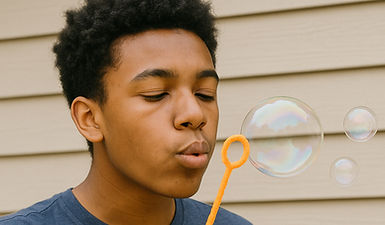
🥼LAB: Finding the Perfect Bubble Mixture
Have you ever tried blowing bubbles using just plain water? It usually fails, because pure water has a surface tension that is too strong for bubbles to stay together. By mixing in a little detergent, the water’s surface tension is reduced, allowing bubbles to form. The mixture can be improved even further by adding ingredients like corn syrup or glycerin - these additions can make bubbles that are tougher and last much longer.
Bubble mixture is a great example of how impure substances often have properties that are more useful than the original pure substance. In this science activity, you will test different mixtures to discover which one creates the best bubbles!
Bubble Mixture Inquiry
ACTIVITY
INSTRUCTIONS: Conduct a mini-inquiry to investigate which bubble mixture produces the best bubbles.
Practise your Science Inquiry Skills by completing all elements of the scientific method in this mini inquiry task.
SUMMARY: Impure Substances
In summary, a mixture (impure substance) contains two or more different particles.
It does not have the same composition all the way through and can be separated by physical methods.
-
Homogeneous mixtures (e.g. salt water, air) look the same throughout. Solutions and alloys belong here.
-
Heterogeneous mixtures (e.g. oil and water, sand and iron) do not look the same, and the parts can often be seen.
GUIDED ACTIVITY
INSTRUCTIONS: WIth your teacher's guidance, complete the Frayer Model summarising pure substances. You will need to: define impure substances, outline characteristics of impure substances, and list examples and non-examples of impure substances.
Frayer Model - Impure Substances
Chemistry Collage
ACTIVITY
INSTRUCTIONS: Use the information from your Frayer Model to create a collage or poster visually summarising impure substances, their characteristics and examples (including particle examples).
SUCCESS CRITERIA CHECKPOINT
CLOZE
✅ Define impure substances.
✅ Outline characteristics of impure substances.
✅ List examples of impure substances
[4] Solutions
Disappearing Act
HOOK
Watch as sugar, then sand, is mixed in water.
-
What differences did you notice between the sugar and the sand after stirring?
-
Did either of them “disappear”? If so, where do you think it went?
-
How could you tell whether the sugar was still present in the water, even though you couldn’t see it?

[FA-1] Mixtures & Separation Techniques
Learn how to ACTUALLY study!
HOOK
1. BEFORE YOU WATCH: Rate your study habits on a scale of 1 to 10:
1 = weak study habits, 10 = strong study habits
2. WATCH the video "Learn How To Actually Study Before It’s Too Late" by ThatGuy.
3. AFTER YOU WATCH:
a) Re-rate your study habits on a scale of 1 to 10.
b) Did your rating change? Why or why not?
c) Outline one strategy from the video you could practise to improve your study habits moving forward.
LEARNING INTENTIONS:
Review & consolidate learning on particles and matter.
SUCCESS CRITERIA:
-
Complete Formative Assessment Tasks #1
-
Use answers to self-assess learning progress.
-
Reflect on learning progress by identifying areas for improvement.
Formative Assessments
Formative assessment is a way for teachers to check how well you're understanding the material while you're still learning it. It's like a practice run before the big test.
The goal is to give you feedback so you can improve and understand the subject better before the final exam.
Formative Assessment #1
ACTIVITY
INSTRUCTIONS:
-
Complete this task in a similar way to how you would do a real test.
-
When you are done, use the answer key (provided by your teacher) to self-assess your responses.

[5] Why Separate Mixtures?
How will you survive?
HOOK
“Imagine this… You are a participant on the reality TV "Alone". You have been dropped into a deserted location with only the following items: metal flask, glass bottle, plastic bottle, 1 m of rope and a box of matches.
You know, you will need fresh water if you are going to survive but the only water sources around you are undrinkable: the ocean and a muddy billabong.
-
What mixtures do you see in this scenario?
-
Which mixtures might be useful if separated?
-
Which mixtures might be dangerous if not separated?

LEARNING INTENTIONS:
Understand the why some mixtures need to be seperated.
SUCCESS CRITERIA:
-
List examples of mixtures (impure substances) that are intentionally separated.
-
Brainstorm and briefly outline methods used to separate mixtures.
Intro to Separating Mixtures
Every day we come across mixtures—whether it’s the air we breathe, the food we eat, or the water we drink. A mixture is made up of two or more substances combined together, and sometimes we need to separate them to make them useful, safe, or valuable. From cleaning dirty water to recycling metals, separating mixtures is an important skill in both survival and modern life.
Mixture Detective
STATIONS
You will receive cards showing different mixtures (e.g., muddy water, soft drink, air, blood, mining ore, salt water, oil and vinegar, recycling waste).
-
Sort the cards into three piles:
-
Safe to use as is
-
Needs separating before use
-
Impossible or useless to separate
-
-
For each card, write:
-
Why might someone want to separate this mixture?
-
What properties (like size, solubility, density, magnetism, boiling point) might make it possible to separate?
-
CHECK ANSWERS
Ways to Separate Mixtures
“Mixtures can be separated in many different ways, depending on the properties of their substances, such as size, solubility, density, or boiling point
Separating Mixtures
STATIONS
1. Watch the video provided.
2. Create a summary document explaining different separation methods. Your document might be:
a) a collage or illustration
b) slides or a summary document
c) other...
SUCCESS CRITERIA CHECKPOINT
CLOZE
✅ List examples of mixtures (impure substances) that are intentionally separated.
✅ Brainstorm and briefly outline methods used to separate mixtures.
[6] Separation by Filtration
TBC
HOOK
1.
[7] Separation by Decantation
TBC
HOOK
1.
[8] Evaporation & Crystallisation
TBC
HOOK
1.
[FA-2] Mixtures & Separation Techniques
TBC
HOOK
1.
[9] Magnetic Separation
TBC
HOOK
1.
[10] Separation by Distillation
TBC
HOOK
1.
[11] Chromatography
TBC
HOOK
1.
[12] Separation Challenge
TBC
HOOK
1.
[FA-3] Mixtures & Separation Techniques
TBC
HOOK
1.